
17 June 2026
From macro shift to metre-by-metre
Trend-literacy only becomes strategic thinking when it resolves into a specific physical decision a person can act on in seconds.
The iF Design trend report for 2026 frames macro shifts as strategic thinking — a useful move, because it treats trends as something to reason with rather than react to. But it stops one step short of the question that matters to anyone who builds physical space. Knowing a shift is happening is not the same as knowing what to change in a room.
This is the gap we work inside. A trend report can tell you mobility is fragmenting, that journeys are now multi-modal, that people expect to move between bus, bike, ride-hail and onward transit without thinking about it. All true. None of it tells you what to put on a pole at a bus stop.
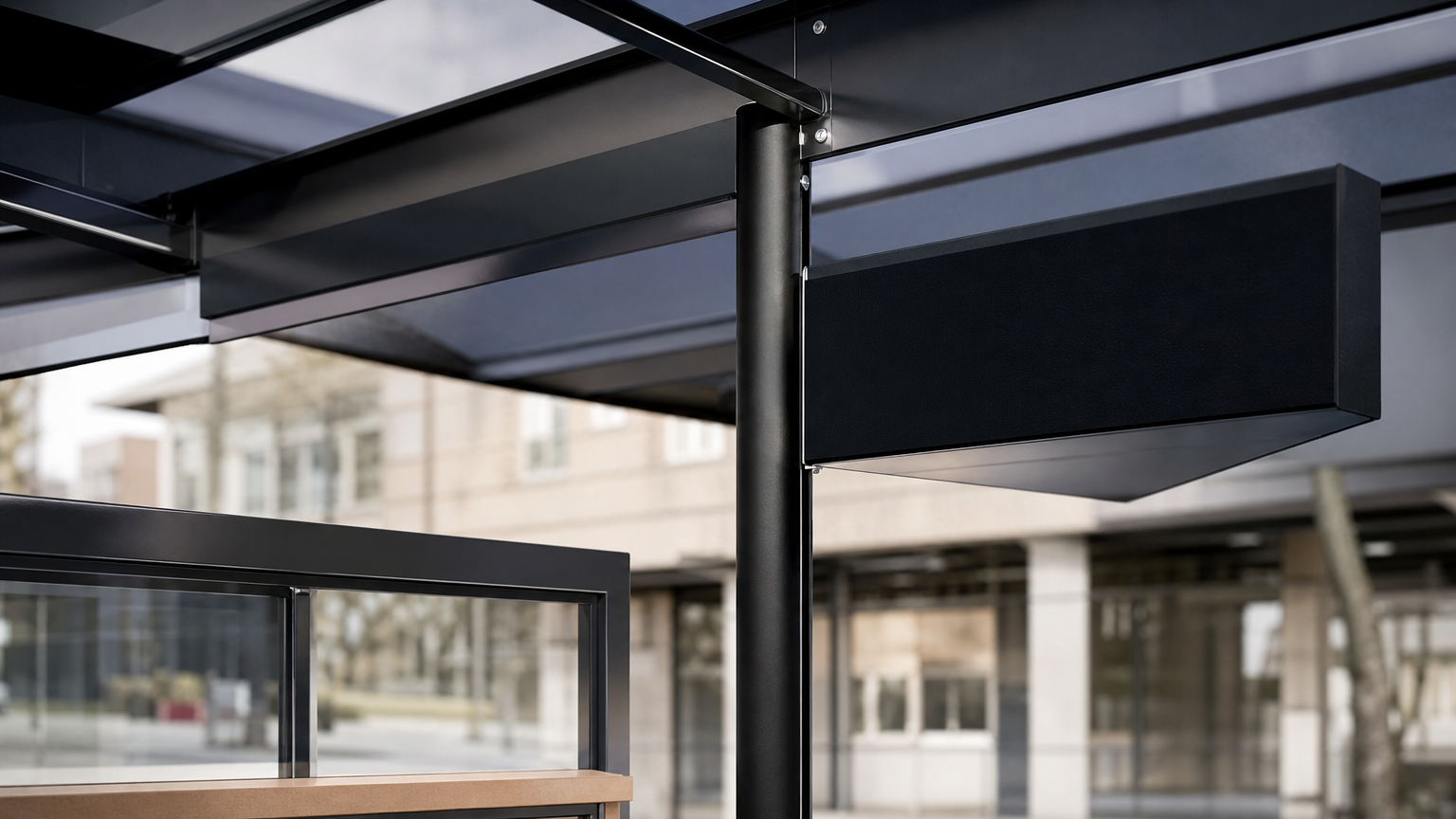
On HVV — The Next Stop, the brief carried exactly that weight. The bus stop, as a form, has not structurally changed in fifty years — a pole, a sign, a roof if you are lucky — while the touchpoint around it has quietly become multi-modal. Cameras, real-time displays, accessibility provisions and journey planners were added over time, each as a separate object, each on its own procurement cycle, none designed to be there together.
The macro shift was obvious. The hard part was the metre.
The question we held was not "what is the future of mobility?" It was narrower and far more demanding: what does a person standing at this stop need to understand in the next few seconds, and what single object could carry all of it at once? That is the moment where strategic thinking earns its name — when it resolves into a placement, a hierarchy, a decision about what the eye finds first.
This is why trend-literacy and spatial decision-making are different skills. One reads the weather. The other decides where to stand. A studio can be fluent in every macro shift and still produce a room that confuses the person inside it, because the translation from theme to physical choice is its own discipline — and it does not happen by quoting the report louder.
What made The Next Stop work was not that we knew mobility was changing. Everyone at UITP 2025 knew that. It was that the shift had been resolved into an integrated touchpoint logic — one object, designed once, doing the work that a dozen retrofitted objects had been doing badly. The thinking was upstream. The proof was a unit you could walk up to and read.
That is the test we would put to any trend report, including a good one: not "is this true?" but "what does it ask me to change in the next four seconds of someone's experience?" If a shift cannot be answered metre by metre, it is still just literacy. The work begins when it becomes a choice.
Start a conversation.
Tell us about the project, even if it's still loose. The first call is about understanding the question — not pitching the answer.
hello@luxoom.com →Luxoom · 17 June 2026
← All writing