
Intro Rooms
Four permanent introductory spaces inside the Humboldt Forum, designed to lead visitors into the collections of the Ethnologisches Museum and the Museum für Asiatische Kunst — and into the discussion the institution chose to lead with around provenance, multiperspectivity, and contemporary relevance.
The Humboldt Forum holds ethnographic collections that carry contested histories. Any object on display can be read traditionally, contemporarily, artistically, and through the colonial frame that brought it to Berlin — and most museum design quietly chooses one of those readings and writes the rest out.
The Stiftung Humboldt Forum brief was for four introductory spaces on the second and third floors that would prepare visitors for that reading: a mindset rather than a wayfinding system, set in transit areas between the central halls and the wing exhibitions.
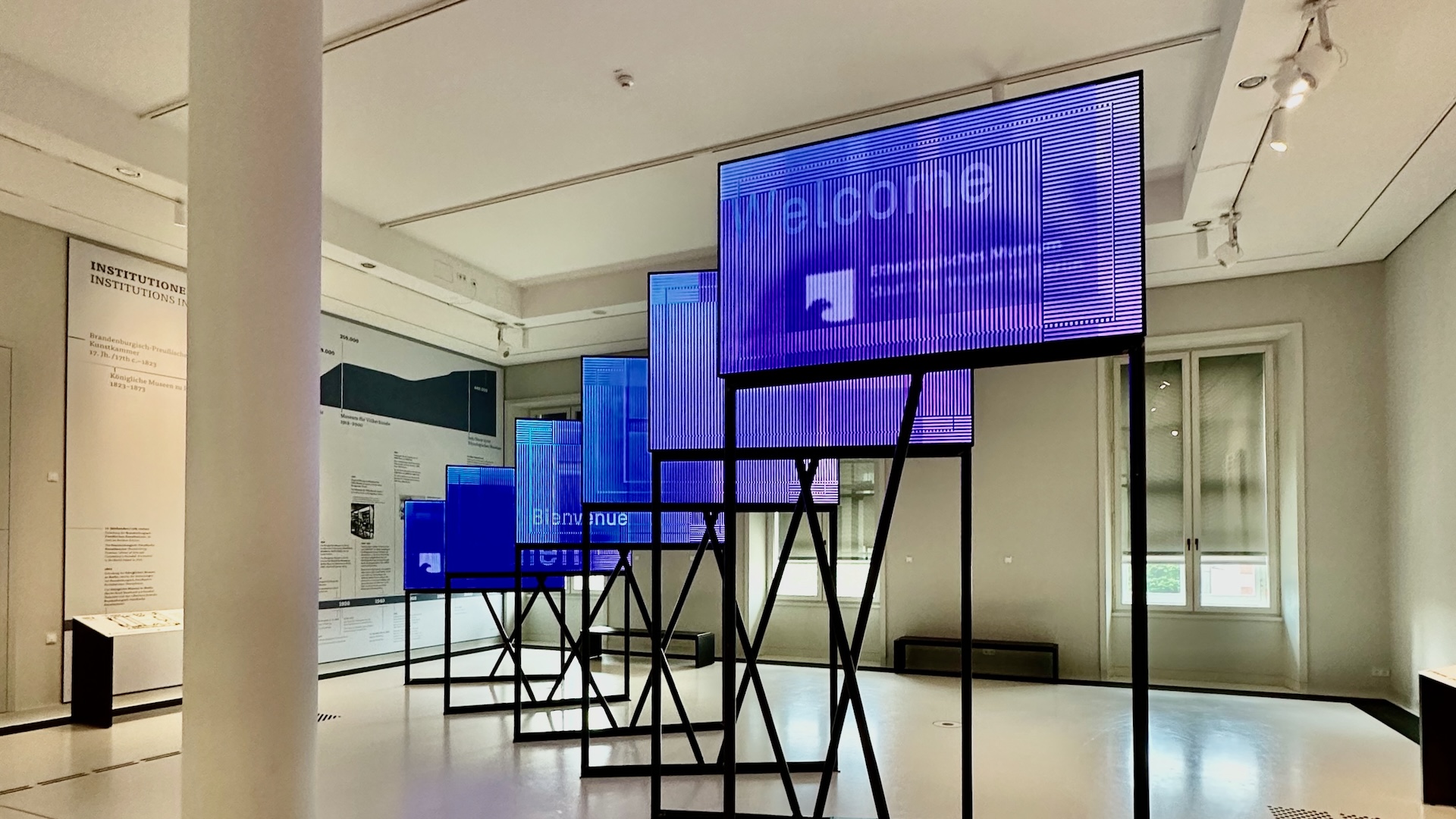
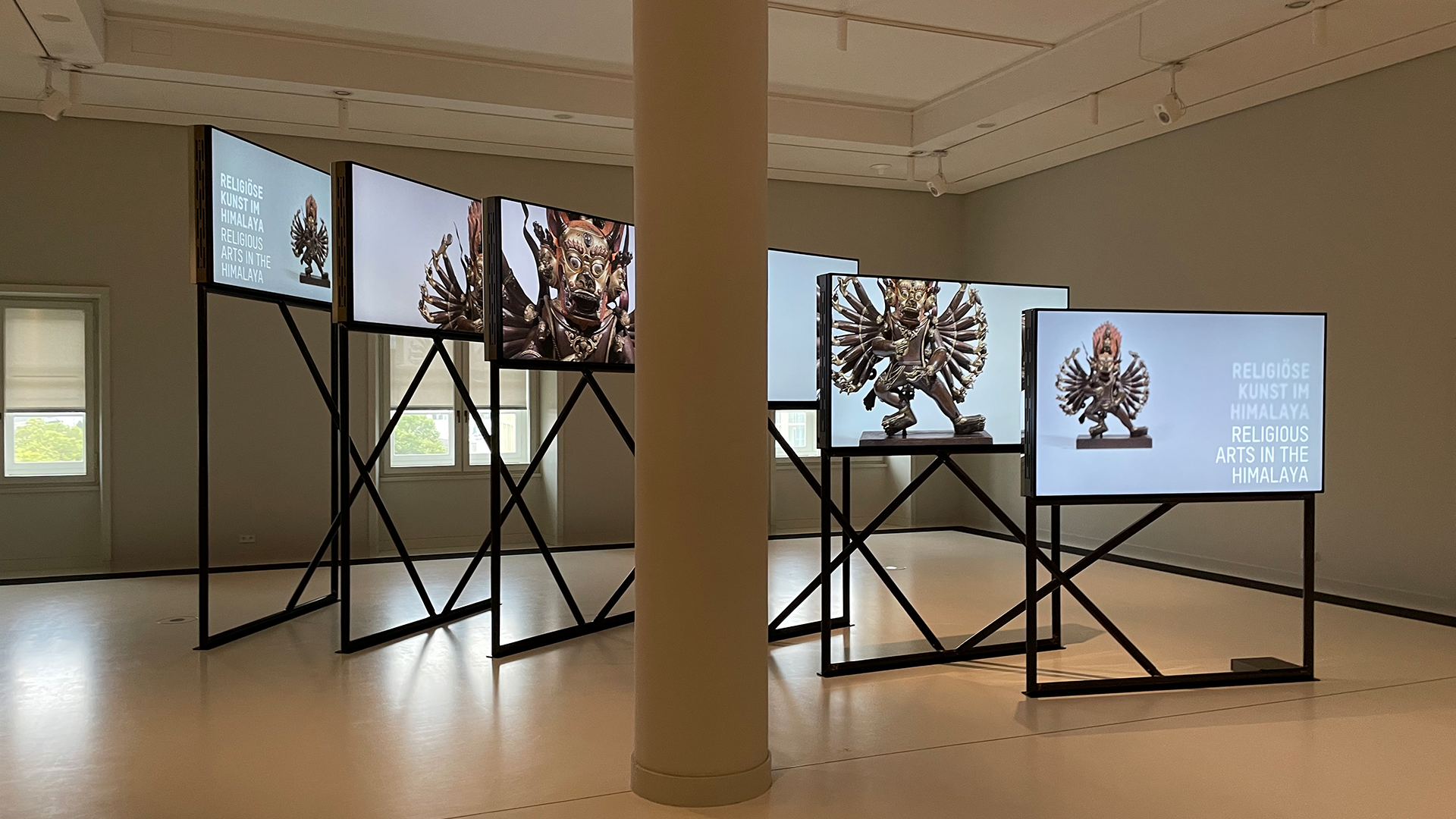
Each of the four rooms received a layered screen installation tuned to its specific geometry — six screens per room, arranged along curves rather than walls. The curves were drawn so that, followed past the edges of each room, they connected visitor, museum and the wider world beyond the building. The architecture of the installation was a statement before any content played: nothing here is square, fixed, or self-contained.
The screens' visual programming alternated short welcome sequences in more than ten languages with object chapters, each chapter placing one piece from the collections — the Luf boat from the South Seas, the Mandu Yenu throne from Cameroon, among many others — inside its historical, social and artistic context, including provenance and collection history. The chapters were short trailer-like sequences, around 45 seconds each, ten to fourteen per room, with the welcome sequences structuring the loop. Across all four rooms, more than 40 sequences were produced.
The layering of the screens meant visitors couldn't see all of it from a single position. To read an object fully, you had to move around it — and that physical movement was the design's argument made tangible. The shift in viewing habit the curators were asking for was rehearsed in the body before it landed in the head.
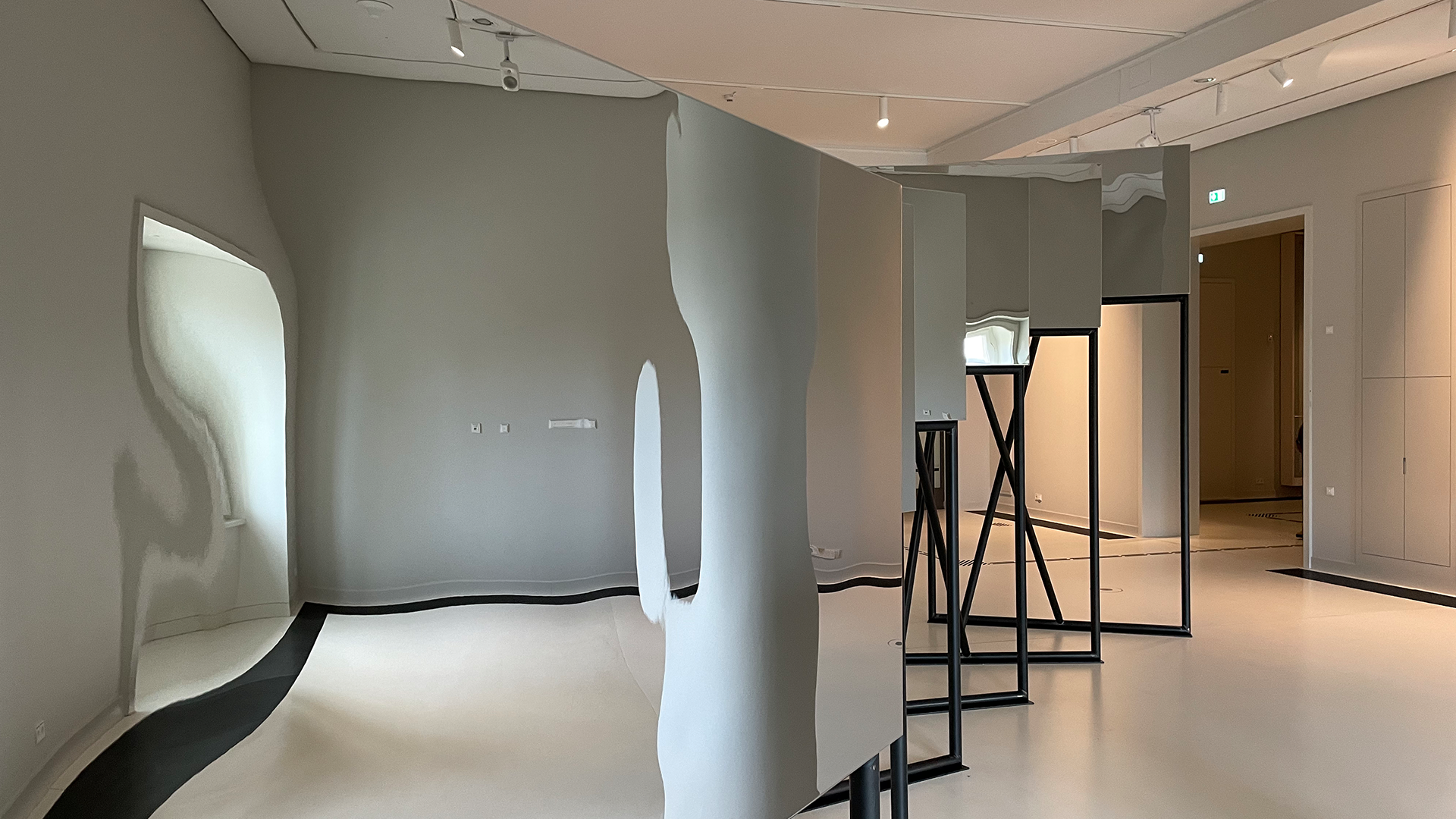
The mirrored backs of the screens carried that further. Each mirror gathered the room, the window views beyond it, and other visitors into the same visual field as the projected content — the strongest connection between what was on screen, where the visitor stood, and the world outside the museum.
A multi-channel sound installation extended the principle into another dimension. Object-specific sound came from the screens themselves; an atmospheric composition came from six ceiling speakers, deliberately asynchronous to the visuals. The two layers behaved independently, so a visitor's acoustic experience also shifted with their position in the room. Sight and sound both rewarded perspective change; standing still rewarded nothing.
The design workflow had to match what was being designed. The four rooms were reconstructed in the Unity 3D engine with a parametric design component layered on top, which meant screen positions and animated visual content could be edited together — moving a screen and seeing the content respond in real time, at eye height, walking through the room. Without that workflow, the relationship between architecture and content would have been impossible to tune at the precision the rooms needed inside a project running just over a year.
The project sits inside Luxoom's longer-running practice of Mediatektur — designing media, space, sound and visitor movement as one — which Andrea Rostásy and Tobias Sievers set out in book form in 2018 and revisited in detail for this project in 2025 (see citation below).
The four Intro Rooms opened in autumn 2021 and are now permanent installations inside the Humboldt Forum, marking the beginning of every visitor's encounter with the collections on the second and third floors. They continue to set the interpretive frame the museums chose to lead with — that the objects on display hold multiple readings, and that seeing all of them is the visitor's work as well as the institution's.
The project is documented in detail in:
Rostásy, Andrea & Sievers, Tobias (2025): Mediatektur. Inszenierung der Introräume der Sammlungen des Ethnologischen Museums und des Museums für Asiatische Kunst der Staatlichen Museen zu Berlin / Mediatecture. Staging the Introrooms of the Collections of the Ethnological Museum and the Museum of Asian Art of the National Museums in Berlin.
In: Benterbusch, Nora (ed.): Spotlights on Media Borders / Perspektiven auf Mediengrenzen. Nomos, Baden-Baden, pp. 377–399. (Comparative Media and Culture Studies, Vol. 1.) ISBN 978-3-7560-3018-7.
View at Nomos →The chapter is co-authored by Andrea Rostásy (media curation, Stiftung Humboldt Forum side) and Tobias Sievers (creative direction, Luxoom).
Tell us about your project.
The first call is about understanding the question — not pitching the answer. Even if the brief is still loose.
hello@luxoom.com→