
A Disclosure Worth Reading
Finn Kortenbrede · 24 August 2026
Article 50 of the EU AI Act gave hvv mia an obligation. Design turned it into a claim the user can believe.

The user's first question is not if it's any good
When a public-facing AI system with a human face starts to speak, the user's first question is not whether it is any good. They are asking whether it is trustworthy and reliable or not.
Trust is a reasonable question. Synthetic faces and voices are now common enough in ordinary media channels. Often realism has become more of a warning sign rather than a reassurance. AI systems have been implicated in security and data privacy incidents that read to a general audience as machines behaving badly on their own account. The public has drawn a reasonable conclusion from all of this: when something looks human and isn't, someone probably wanted you not to notice.
We do quite a bit of interface and interaction design for AI-based systems, and this question now arrives in most of them. It arrives earliest and hardest in public-facing work, where the user did not choose the tool, has no stake in its success, and can simply walk away. This article works through how we're answering it on one such project—hvv mia, a conversational AI mobility assistant for public transit, currently in development and prototype testing—and why the answer turns out to be one key in making the system usable at all.

The article 50 regulation, and the way it is read
Article 50 of the EU AI Act has been applicable since August 2nd, 2026. It requires that a person has to be informed, not later than first contact, that they are interacting with an AI system or with AI-generated content, especially in public information context. [1]
It is widely discussed as a labelling obligation and a compliance burden that interface designers must accommodate without degrading the experience they are building. That perception and framing mistakes the instrument for its purpose. We say that Article 50 is an anti-deception rule wearing a labelling rule's clothes. What it specifies is an outcome: a person knows what they are dealing with, and knows it early enough for the knowledge to matter.
What it does not specify is a layout. The EU's icon set containing a generic basic symbol for any AI involvement, an "AI generated" label for content produced without human editorial control, an "AI modified" label for human-made content that AI has altered is a suggestion, not a compliance guarantee. [2] There is no detailed guidance on how the icons must be applied in a real interface, and sensibly there cannot be: the range of design situations this rule will land in is not foreseeable, and premature specificity would do more harm than good.
So the regulation hands over a goal and leaves the application part to design judgment. The rule says a disclosure must be clearly perceptible. It does not, and cannot, say where on a busy screen perceptibility is actually won or lost.

Two ways to receive a requirement
The first way is to satisfy it. A badge in the lower right corner, a line of speech before the session starts, a checkbox somewhere in the release process. This is legally clean, cheap, and in an environment that already distrusts AI, actively counterproductive because a minimal disclosure is legible as such. Users can tell the difference between a system that is informing them and a system that is covering itself, and they draw conclusions accordingly.
The second way is to ask what the requirement is trying to produce and then ask whether that outcome is something the project wants anyway. For hvv mia the answer was yes, and emphatically. The rule wants a user who knows they are talking to a machine. We want a user who knows they are talking to a machine, because everything else about the product depends on it. That alignment is not automatic. Plenty of obligations serve interests other than the project's. But where it exists, the job changes. The requirement stops being a box to check but becomes material to work with: a reason and a vocabulary for saying something we needed to say regardless.
Why the face makes this acute
hvv mia uses a photorealistic human face. The reason is interaction mechanics, not humanization or building trust. Human dialogue works efficiently because it follows established patterns, and those patterns set our expectations for how an exchange should run — which means a face recruits a set of expectations users already hold, and they apply them to a conversational interface without deciding to. [3] That improves the usability of a spoken exchange regardless of whether a human face makes a system seem more credible.
But the same realism that makes the exchange legible as conversation is what reads, in this environment, as an attempt to pass. The face is the element a user would point to if asked what felt deceptive about the system. Which means it is a liability right up until it is flagged, and an asset immediately afterwards. The usability benefit we chose the avatar for is not collectable until the suspicion it creates has been paid off.
This is the specific risk Article 50 does not fully avert on its own. An interface can be correctly labelled and functionally invisible at the same time, and the difference between the two is a design decision.
Say it twice
There is a long evidence base on the gap between a notice existing and a notice being registered. Nouwens et al. scraped 680 real-world cookie-consent implementations across the most-visited UK sites, and in a companion field experiment found that layout choices alone moved measured consent by double-digit percentage points regardless of what the notice said. [4] The subject is cookie banners, not AI disclosure, and it is one example among many in a literature that has been consistent for two decades. The general finding can be translated: a notice can satisfy a rule about what must be disclosed while its placement determines whether the disclosure is registered, dismissed, or effectively unseen. Banner blindness is not a failure to see. [5] It is a learned inference, and usually a correct one.
Applied to hvv mia, this points somewhere more specific than "make the badge bigger."
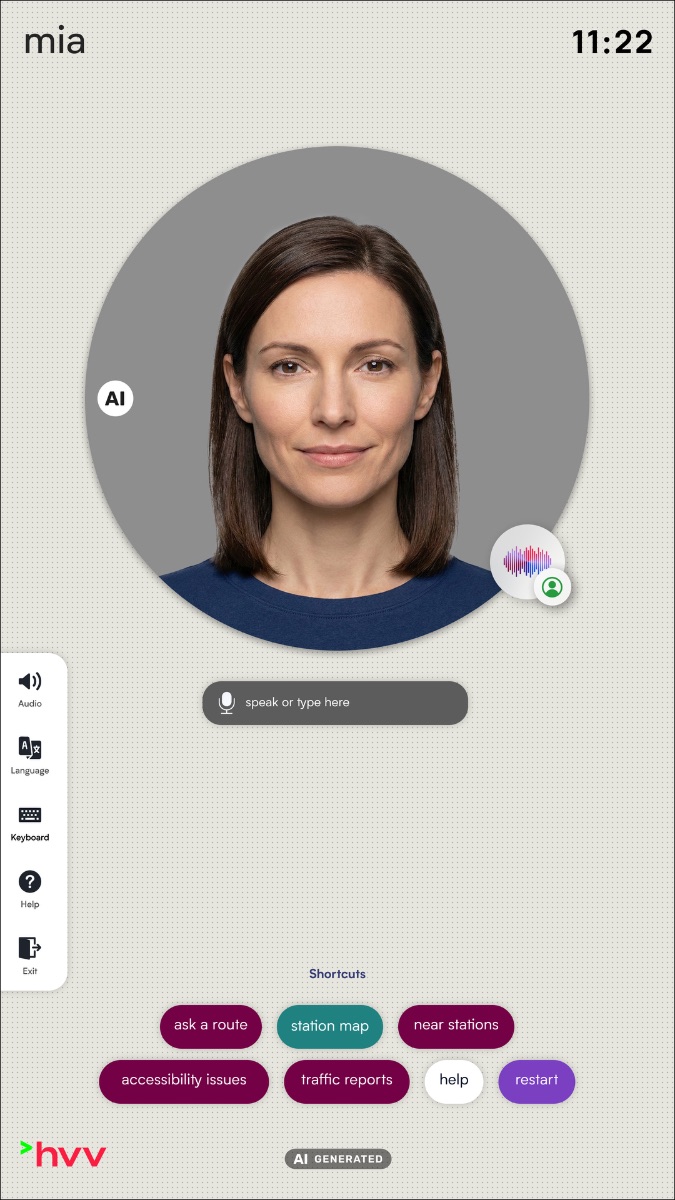
The screen has two centres of attention, not one. The avatar is one. The live transcript of the dialogue is the other, and it competes with the face rather than losing to it. They fail differently. The face is what reads as human but it is the element that could be mistaken for a person. The transcript is what reads as authoritative and it is the element whose statements about departure times and disruptions will be acted on.
Those are two different implicit promises, and one disclosure cannot cover both. So hvv mia places the generic Basic Symbol directly beside the avatar, at the point where a gaze arrives first—together with mentioning being an AI assistant in the first spoken sentence. And it places the "AI Generated" tag on the overall UI frame below the transcript, where the content claim is being made. Each label focuses a different the risk, together they tell the user: we want you to know.
What a stance costs
Most interfaces are mostly furniture. Legal text, cookie notices, the small print at the bottom of a form. A user has learned that these elements are addressed to no one, put there because something required them. Users have learned that a badge in a corner is furniture, and they are usually right.
A stance is different. A stance is addressed to you, it can be disbelieved, and it costs the system something to take. That is what makes it worth reading because a claim that could be tested is a claim someone chose to make.
A disclosure, placed where disclosures go, is furniture. Two disclosures, placed where the user is already looking, are a position: we would rather you were certain than comfortable. Nothing about the second one adds information the first did not carry. What it adds is evidence of intent. A system trying to pass as human does not tell you twice.
This is the whole mechanism. The user arriving at hvv mia is not asking first whether it is good. They are asking whether it is trustworthy, and until that question is settled they will read everything the system does as evidence for or against it. A disclosure they register as furniture leaves the question open. A disclosure they register as a stance frames the question and having the question framed, every question they have about the transit network is available to be asked. Being outspoken about AI-generation of contents, trust is manageable.
What we cannot answer: how does this affect AI-literacy?
One question this work raises and cannot settle: if disclosure becomes reliable and ubiquitous, does people's own unprompted ability to tell an AI system from a human one begin to erode? And do people have that ability to begin with?
Research on automation complacency shows that operators' monitoring of automated systems degrades once that automation has proven reliable, that the effect appears in novices and experts alike, and that it resists correction through practice. [6] That work concerns supervisory attention to task-performing automation, not the perceptual judgment involved in recognising an artificial interlocutor, so it is not direct evidence. But the analogy is fair enough to state: if a labelling regime consistently does the noticing for you, the noticing may atrophy, with consequences for the cases where a label is missing, delayed, or false.
This is not an argument for disclosing less, and it is not a question a single project working under the AI Act can answer. It belongs to politics and to public debate, where the trade-off between a protective regime and the capacities that regime displaces is properly argued. Our obligation is narrower: to design well inside the regime that exists, and to say plainly where its long-run effects are unknown.
Sources:
1. Regulation (EU) 2024/1689 (Artificial Intelligence Act), Article 50 — Transparency obligations for providers and deployers of certain AI systems. Applicable from 2 August 2026.
2. European Commission, Digital Strategy, "EU icons for labelling AI-generated content." The framework distinguishes a generic Basic Symbol for any AI involvement, an "AI Generated" label for content produced without human editorial control, and an "AI Modified" label for human-made content that AI has altered. Article 50 requires that whichever applies be clearly perceptible and distinguishable at first contact, and permits that requirement to be met through interface treatment rather than only by embedding a mark in the content itself. → digital-strategy.ec.europa.eu/en/policies/eu-icons-labelling-ai-generated-content (Retrieved August 2026.)
3. Rostásy & Sievers, Handbuch Mediatektur, transcript Verlag, Bielefeld 2018, pp. 218 ff. The section's conclusion (p. 221): "Menschlicher Dialog funktioniert effizient, weil er bestimmten Mustern und Abläufen folgt. Diese Muster und Abläufe definieren somit auch unsere Erwartungen daran, wie Dialog und Interaktion ablaufen sollten. Zusätzlich zu einem effizienten Ablauf muss ein Dialog für uns relevant sein, damit wir diesem folgen." — Human dialogue is efficient because it follows particular patterns and sequences; those patterns in turn define our expectations of how dialogue and interaction should proceed; and beyond efficiency, a dialogue must be relevant to us if we are to follow it.
4. Nouwens, Liccardi, Veale, Karger & Kagal, "Dark patterns after the GDPR: Scraping consent pop-ups and demonstrating their influence," Proceedings of the 2020 CHI Conference on Human Factors in Computing Systems. Of 680 consent implementations sampled across the ten thousand most-visited UK websites, only 11.8% met a minimal legal baseline. A companion field experiment found that removing an opt-out button from the first screen raised measured consent by 22–23 percentage points, while presenting granular choices on that same first screen reduced it by 8–20 percentage points.
5. Benway, "Banner blindness: The irony of attention grabbing on the World Wide Web," Proceedings of the Human Factors and Ergonomics Society Annual Meeting 42(5), 1998, 463–467 — the first usability reporting of the pattern. Nielsen's original eyetracking work established it qualitatively, finding almost no fixations within advertisements: "Banner Blindness: The Original Eyetracking Research," Nielsen Norman Group, 20 August 2007. The quantification came a decade later: in Pernice's revisit, a single fixation out of 148 landed in a right-hand rail occupying roughly a quarter of the content area — 0.8% of attention for 25% of the space, an undershoot of more than thirtyfold. → Kara Pernice, "Banner Blindness Revisited: Users Dodge Ads on Mobile and Desktop," Nielsen Norman Group, 22 April 2018. nngroup.com/articles/banner-blindness-old-and-new-findings
6. Parasuraman & Manzey, "Complacency and bias in human use of automation: An attentional integration," Human Factors 52(3), 2010, 381–410.
Finn Kortenbrede · 24 August 2026
How We Work